The Nest: The Home Revolution Is Here!

I’ve been working in real estate since 1979, so I’ve seen a lot.

My feeling is that we are in a housing crisis because we aren’t approving enough housing. Construction is not the issue – Canadian builders are amongst the most skilled in the world. 

Getting a new home project approved takes several years and can cost hundreds of thousands of dollars. That’s where the bottleneck is.

So, I am thrilled to have played a role in shaping the vision for the development of a new home community that’s the most innovative I have ever seen in Ontario. It offers an unmatched opportunity, with detached homes starting from $399K.

Imagine a 100+ acre site with only natural gas and electricity services available. Normally, such a site would have to wait years for municipal water and sewer infrastructure to become available – a costly, time-consuming and complex process. 

Enter The Nest, a revolutionary new home community in Seguin Township, beside Parry Sound, envisioned by Hall Development Group, an arm of Hall Construction. This company is using its expertise in land servicing and earthworks to create private water and sewer infrastructure. Private individual septic systems and wells shared by up to five homes are the reasons this new home community was able to be conceived and launched in record time and at prices never before seen.

It took conviction and past experience to believe in the viability of the vision and then work with the Hall team to execute it. The Nest offers a bold new model for how housing in Ontario can be built and approved.

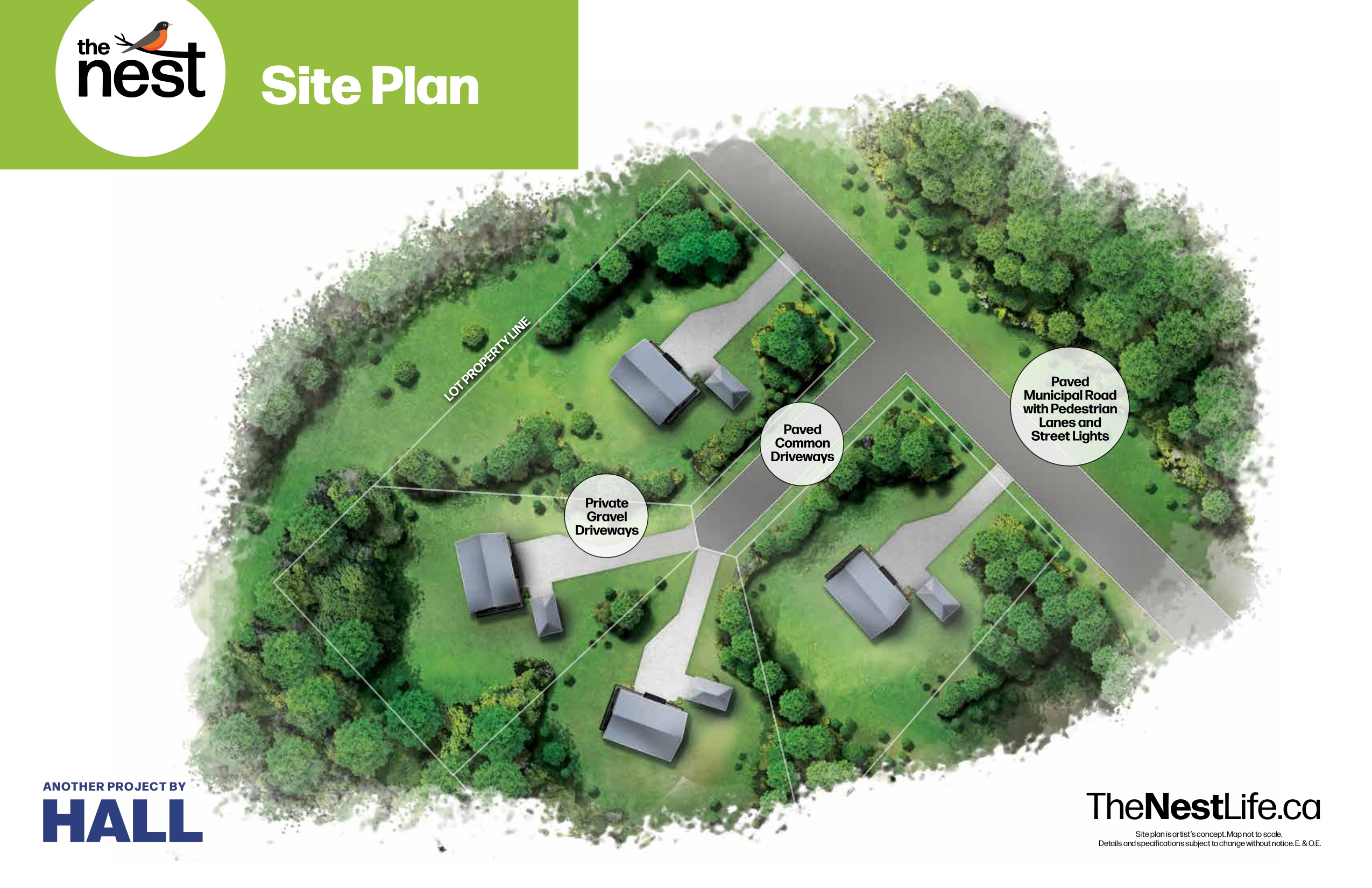
Also unique are the condo tenure with homeowner land ownership and the siting of the homes in clusters of five homes set into the natural landscaping to minimize disruption, as opposed to overwhelming the environment with rigid subdivision design. Even the architecture of these right-sized homes is refreshing.

Kudos to Seguin Township for embracing Hall’s vision and for helping to make it happen – it’s encouraging to see such bold and progressive leadership.

Visit TheNestLife.ca to learn more. I’d love to hear what you think.

Canada’s Housing Crisis: Why Our Leaders Are Failing Us

Why, at a time when we most need action and results, are our leaders failing us again?

While the federal government’s rental incentives have contributed to a meaningful increase in new purpose-built rental construction, overall new home construction has crashed to early 1990s levels, the lowest in 30 years. This is alarming when our population has grown by 11 million people – an increase of one third.

It seems like there is a movement to deter real estate investors, but who else is going to buy an un-built condo and wait several years for it to be completed? A better approach could be for the government to encourage condo builders to proceed with construction by co-insuring construction loans prior to achieving 70-75% presales as required by lenders. This would stimulate condo construction and offer quicker move-in dates to end-user buyers.

Toronto imposed a vacant home tax, which has been an administrative disaster and will likely cost more to administer than it will increase the supply of rental properties.

The Province of Ontario has passed much legislation aimed at reducing red tape and NIMBYism, but without the cooperation of municipalities, many of the policies are ineffective. For example, when the Province tried to speed up development approvals, municipalities shot back with new procedures, such as pre-consultations aimed at slowing down the approval process and reducing pressure on municipalities to meet provincially mandated deadlines.

As Mark Carney stated in his Globe and Mail article on Dec. 30, 2024, “We need Canadian builders to be unleashed…to build housing, energy, technology, communities and security.” Governments can achieve this by getting out of the way, and eliminating restrictions rather than imposing them. In addition, all levels of government need to step up and work together, across political lines and provincial borders, rather than continue with the siloed approaches being taken by Trudeau, Doug Ford, and Olivia Chow, for example.

And as claimed by Professors Pandes and Robinson in The Globe and Mail on Dec. 31, 2024: “Recent tax changes have made Canada even less attractive for private investment. Raising the marginal tax rates on income and capital gains means Canadian entrepreneurs will be further inclined to sell their businesses early instead of investing time and effort to grow them into global champions. This not only stifles innovation in key industries of the future, but it also sends the message that success is penalized in Canada, rather than celebrated.”

While I love the social safety nets our Canadian society provides, I fear they somehow compete and conflict with our need to be entrepreneurial and competitive in the business world.

Some Canadians seem to view business success as a bad thing and some of us even consider wealth to be evil. And our disdain for builders and developers only exacerbates our housing crisis, as all levels of government fear associating with the suppliers of our most needed infrastructure – housing. 

Overcoming Market Paralysis: Why Builders Must Act Now on the GST Cut

Canada’s housing market is in dire straits. I haven’t seen it this bad since the early 1990s.

Most government initiatives are failing to stimulate construction. The main exception is federal rental construction incentives, which have spurred rental construction to levels not seen in decades. Some government initiatives are actually deterring new home construction, such as the federal Liberal promise of GST cuts for first-time buyers of new homes. The longer it takes for the GST cut to be implemented, the longer buyers will delay their purchase in hopes of securing a lower, more attractive purchase price.

Finally, Mattamy Homes has decided to act upon this by guaranteeing the GST cut now, before it is formally implemented.

I have been recommending this approach for months. I even lobbied Scott Aitchison (Conservative housing critic and shadow minister) and Nate Erskine-Smith (recently replaced federal housing minister) to make the GST cut on new homes effective immediately, to no avail.

Buyers are sitting on the fence, anticipating further price drops and waiting for the GST cut. Psychology is the main obstacle, so we need to overcome the buyer’s mental and emotional hurdles.

I recommend offering price guarantees and passing on GST savings to buyers right now.

Agreements of Purchase and Sale (APS) can be written as an option to buy in July, when new GST rules are expected to be in effect. Alternatively, the APS can state that the agreement will be rewritten after July 2 – but regardless, the buyer gets the original fixed price. The buyer must warrant that they are a first-time buyer, and the APS is cancelled if the buyer does not qualify for any reason.

We need more aggressive, psychology-informed marketing strategies if we want new home buyers to return to the market.

Why I Support Airbnb Restrictions in Canada

Generally speaking, I consider myself to be open to entrepreneurship and capitalism. I believe in open markets. At the same time, the rules need to be fair for all of us, and benefit as many of us as possible.

So, I’ve always had a problem with Airbnbs where they compete with commercial alternatives who pay commercial property and income taxes, like hotels do.

I also don’t understand how a property that is zoned residential can be used for commercial purposes. How is that fair to neighbours, ratepayers, and legitimate competing businesses?

I think restricting Airbnbs makes a lot of sense in areas where we have housing shortages. 

I support the latest federal tax initiative to block people from deducting expenses on short-term rentals in areas where those services are already limited by other levels of government.

Another idea proposed by Housing Minister Sean Fraser is to make existing properties tied up on short-term rental platforms available to prospective long-term renters and buyers.

Another way to reduce Airbnbs might be for the Province of Ontario to make it more attractive for landlords to rent under the Residential Tenancies Act.

What are your thoughts? Comment below!

An Idea to Improve Housing Affordability

Recent polls suggest that many renters believe they’ll never own their own home due to lack of affordability. High home prices and interest rates are the main barriers.

We need big ideas and solutions to help prospective homeowners, especially first-time buyers.

Here’s an idea I think could help, however, I’m proposing it only as an example of how we need to think “out-of-the-box” to move the needle.

How about if every first-time home buyer was allowed to choose to claim their mortgage interest payments as a tax deduction (thereby reducing their income tax burden and increasing their after-tax cash flow) in exchange for being obligated to pay capital gains tax in the future, if applicable, on any appreciation in the value of their property upon disposition (thereby reducing their net proceeds)? This is the practice in the U.S. In effect, this would mean paying tax in the future in exchange for a tax break during ownership.

First-time home buyers who are not interested could follow the current practice of not deducting their mortgage interest payments and not paying capital gains on their home’s appreciation.

Seems to me there is no shortage of ideas and possible solutions. In my opinion, there is a shortage of political and societal will and understanding.

Builders and developers are not the cause of our housing crisis. We are forever accusing them of greedily filling their own pockets at society’s expense, so we restrict their ability to deliver housing and society pays the price through lower supply and higher prices. How ironic.

What are your thoughts? I’d love to hear! Leave a comment or connect with me on LinkedIn to join the discussion.

Previous Older Entries