The Nest: The Home Revolution Is Here!

I’ve been working in real estate since 1979, so I’ve seen a lot.

My feeling is that we are in a housing crisis because we aren’t approving enough housing. Construction is not the issue – Canadian builders are amongst the most skilled in the world. 

Getting a new home project approved takes several years and can cost hundreds of thousands of dollars. That’s where the bottleneck is.

So, I am thrilled to have played a role in shaping the vision for the development of a new home community that’s the most innovative I have ever seen in Ontario. It offers an unmatched opportunity, with detached homes starting from $399K.

Imagine a 100+ acre site with only natural gas and electricity services available. Normally, such a site would have to wait years for municipal water and sewer infrastructure to become available – a costly, time-consuming and complex process. 

Enter The Nest, a revolutionary new home community in Seguin Township, beside Parry Sound, envisioned by Hall Development Group, an arm of Hall Construction. This company is using its expertise in land servicing and earthworks to create private water and sewer infrastructure. Private individual septic systems and wells shared by up to five homes are the reasons this new home community was able to be conceived and launched in record time and at prices never before seen.

It took conviction and past experience to believe in the viability of the vision and then work with the Hall team to execute it. The Nest offers a bold new model for how housing in Ontario can be built and approved.

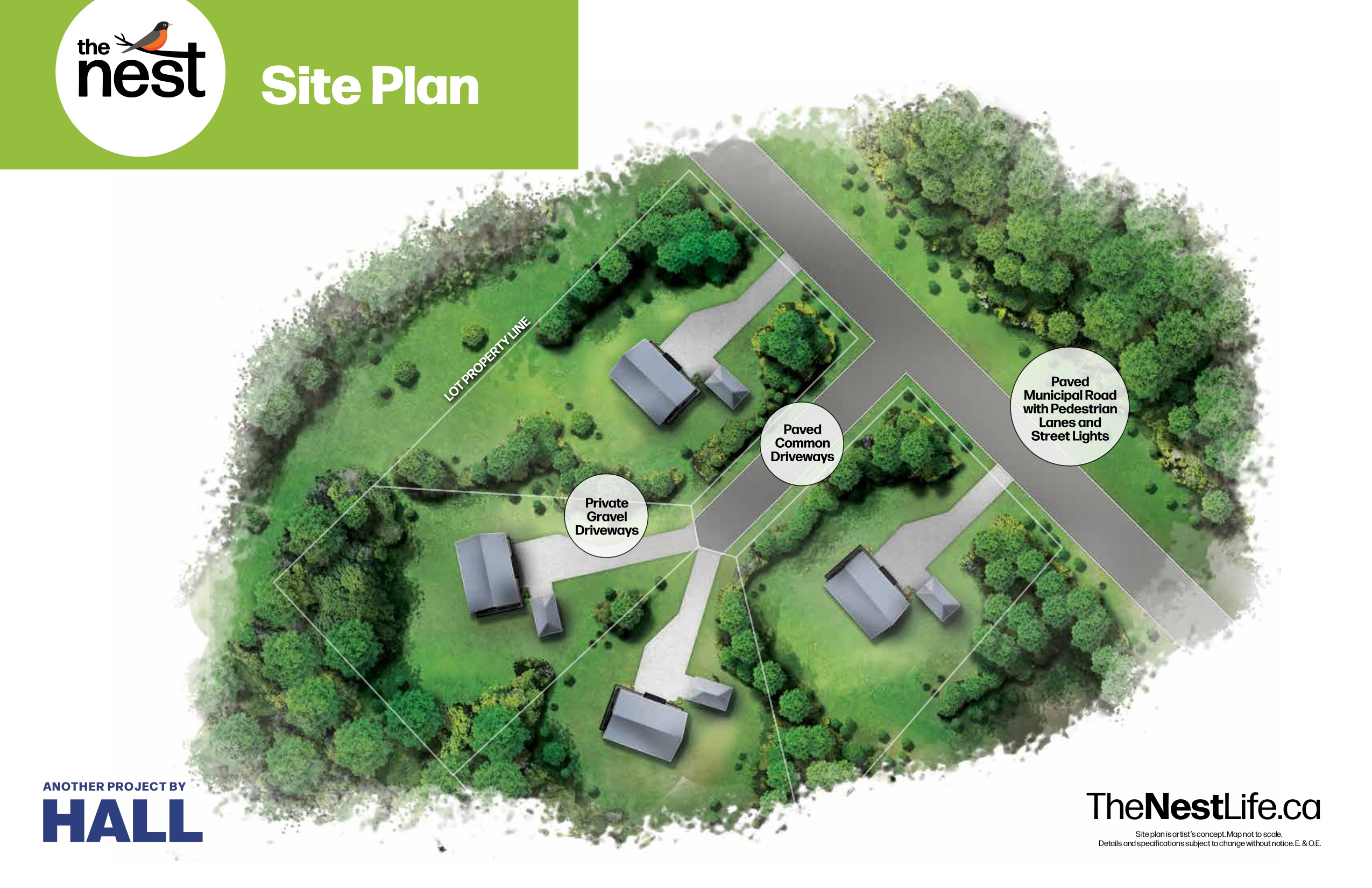
Also unique are the condo tenure with homeowner land ownership and the siting of the homes in clusters of five homes set into the natural landscaping to minimize disruption, as opposed to overwhelming the environment with rigid subdivision design. Even the architecture of these right-sized homes is refreshing.

Kudos to Seguin Township for embracing Hall’s vision and for helping to make it happen – it’s encouraging to see such bold and progressive leadership.

Visit TheNestLife.ca to learn more. I’d love to hear what you think.

Overcoming Market Paralysis: Why Builders Must Act Now on the GST Cut

Canada’s housing market is in dire straits. I haven’t seen it this bad since the early 1990s.

Most government initiatives are failing to stimulate construction. The main exception is federal rental construction incentives, which have spurred rental construction to levels not seen in decades. Some government initiatives are actually deterring new home construction, such as the federal Liberal promise of GST cuts for first-time buyers of new homes. The longer it takes for the GST cut to be implemented, the longer buyers will delay their purchase in hopes of securing a lower, more attractive purchase price.

Finally, Mattamy Homes has decided to act upon this by guaranteeing the GST cut now, before it is formally implemented.

I have been recommending this approach for months. I even lobbied Scott Aitchison (Conservative housing critic and shadow minister) and Nate Erskine-Smith (recently replaced federal housing minister) to make the GST cut on new homes effective immediately, to no avail.

Buyers are sitting on the fence, anticipating further price drops and waiting for the GST cut. Psychology is the main obstacle, so we need to overcome the buyer’s mental and emotional hurdles.

I recommend offering price guarantees and passing on GST savings to buyers right now.

Agreements of Purchase and Sale (APS) can be written as an option to buy in July, when new GST rules are expected to be in effect. Alternatively, the APS can state that the agreement will be rewritten after July 2 – but regardless, the buyer gets the original fixed price. The buyer must warrant that they are a first-time buyer, and the APS is cancelled if the buyer does not qualify for any reason.

We need more aggressive, psychology-informed marketing strategies if we want new home buyers to return to the market.

An Idea to Improve Housing Affordability

Recent polls suggest that many renters believe they’ll never own their own home due to lack of affordability. High home prices and interest rates are the main barriers.

We need big ideas and solutions to help prospective homeowners, especially first-time buyers.

Here’s an idea I think could help, however, I’m proposing it only as an example of how we need to think “out-of-the-box” to move the needle.

How about if every first-time home buyer was allowed to choose to claim their mortgage interest payments as a tax deduction (thereby reducing their income tax burden and increasing their after-tax cash flow) in exchange for being obligated to pay capital gains tax in the future, if applicable, on any appreciation in the value of their property upon disposition (thereby reducing their net proceeds)? This is the practice in the U.S. In effect, this would mean paying tax in the future in exchange for a tax break during ownership.

First-time home buyers who are not interested could follow the current practice of not deducting their mortgage interest payments and not paying capital gains on their home’s appreciation.

Seems to me there is no shortage of ideas and possible solutions. In my opinion, there is a shortage of political and societal will and understanding.

Builders and developers are not the cause of our housing crisis. We are forever accusing them of greedily filling their own pockets at society’s expense, so we restrict their ability to deliver housing and society pays the price through lower supply and higher prices. How ironic.

What are your thoughts? I’d love to hear! Leave a comment or connect with me on LinkedIn to join the discussion.

People Don’t Buy Products – They Buy Ideas

Untitled

People don’t buy products. Sure, they go into the store, talk to someone who works there, choose the colour/model, and they make a purchase; however, there is more to it than that. People buy ideas, and a community. There are a few excellent examples of this. The most obvious is Apple. The product itself – generally – tends to take a backseat to the overall vision of the company, and the feeling that owning a piece of that vision gives you. Fitbit is similar, in that owning one makes you part of a community focused on like-minded lifestyle and fitness aspirations.

It seems like a given that all products would be marketed this way – except that it isn’t. It’s not something that is practiced across the board. Understandably, it isn’t easy to create a brand that “transcends” the products they sell. Few consumers purchase a Dell computer because they want to be part of a larger movement they represent.

So how does this concept translate to the real estate world? Well, purchasing a home is more than just buying a physical structure. It’s about buying a place to raise your family. A place to make new friends, experience monumental life events and live your day-to-day life. Elements such as granite countertops, stainless steel appliances and hardwood floors are great things to offer, but they should always take a backseat to the macro concept of what homebuyers are really buying.

As marketers, we’re responsible for helping to sell dreams. We’re selling the promise of a better life – something that we all want for ourselves, and our families. When it comes to real estate, we’re directly responsible for helping to connect the people with builders, by focusing on the things that – at the end of the day – matter the most. That’s something to be proud of.

Metrics: Understanding The Habits Of Your Consumers

how-to-use-google-analytics

There aren’t many things that you would generally do without any research or insight. Can you imagine buying a car, building an addition to your home or doing an archaeological dig without doing ample planning and/or necessary surveying? Well, when it comes to marketing online, the mindset should be absolutely no different. How can you accurately strategize or make decisions around your online marketing – whether it be your website or social campaign – without understanding your audience and how they interact with your brand/product? For this reason, metrics are essential to not only gather, but also analyze.

Sounds like common sense, right? Not quite. In fact, a report by Grovo suggests that 90% of all (annual) digital advertising dollars across the board are spent without knowing whether or not they were effective. That sounds like a red flag if I’ve ever heard one!

Metrics, if planned into your overall strategy, can do a few things: tell you where, when and how your audience is interacting with your site/brand, and highlight where you’re losing them. It’s important to understand the habits, hotspots, pitfalls and potential dead zones. It will help to further shape, modify and optimize your messaging and content to better satisfy your audience, their needs and their concerns. This is true of not only your website, but your social networks. Listening to feedback, measuring engagement with your content, and understanding demographics and consumption patterns will help you to properly use the networks for optimal results.

What is the result of data analysis? More engagement, more leads and fewer complaints/questions. To top it off, you’re guaranteed to save advertising dollars. Being able to understand your audience and their lifestyles will help you to deliver more relevant marketing, which will inevitably give better bottom line results – it’s a no brainer. This type of information is readily available, and gathering it in-house, or by 3rd party, should be a priority when it comes to evaluating the effectiveness of your digital efforts.

Previous Older Entries