
Messenger for Business: Increasing Engagement with Homebuyers

Untitled

Amidst reports of its decline, Facebook continues to dominate all aspects of social media ­– and many aspects of general web activity. With over 90% of all brands reporting that Facebook is an element of their marketing plan, it’s clear that the platform is healthier than ever. This past March at their annual F8 conference, Facebook unveiled another way that businesses will be able to utilize the platform to engage directly with their audience: Messenger for Business. In simplest terms, the development tool will allow businesses to better integrate Facebook’s native messenger chat into their websites, which will allow for next level to live-chat capability.

What can this new development mean for homebuyers and builders alike? Let’s explore a scenario.

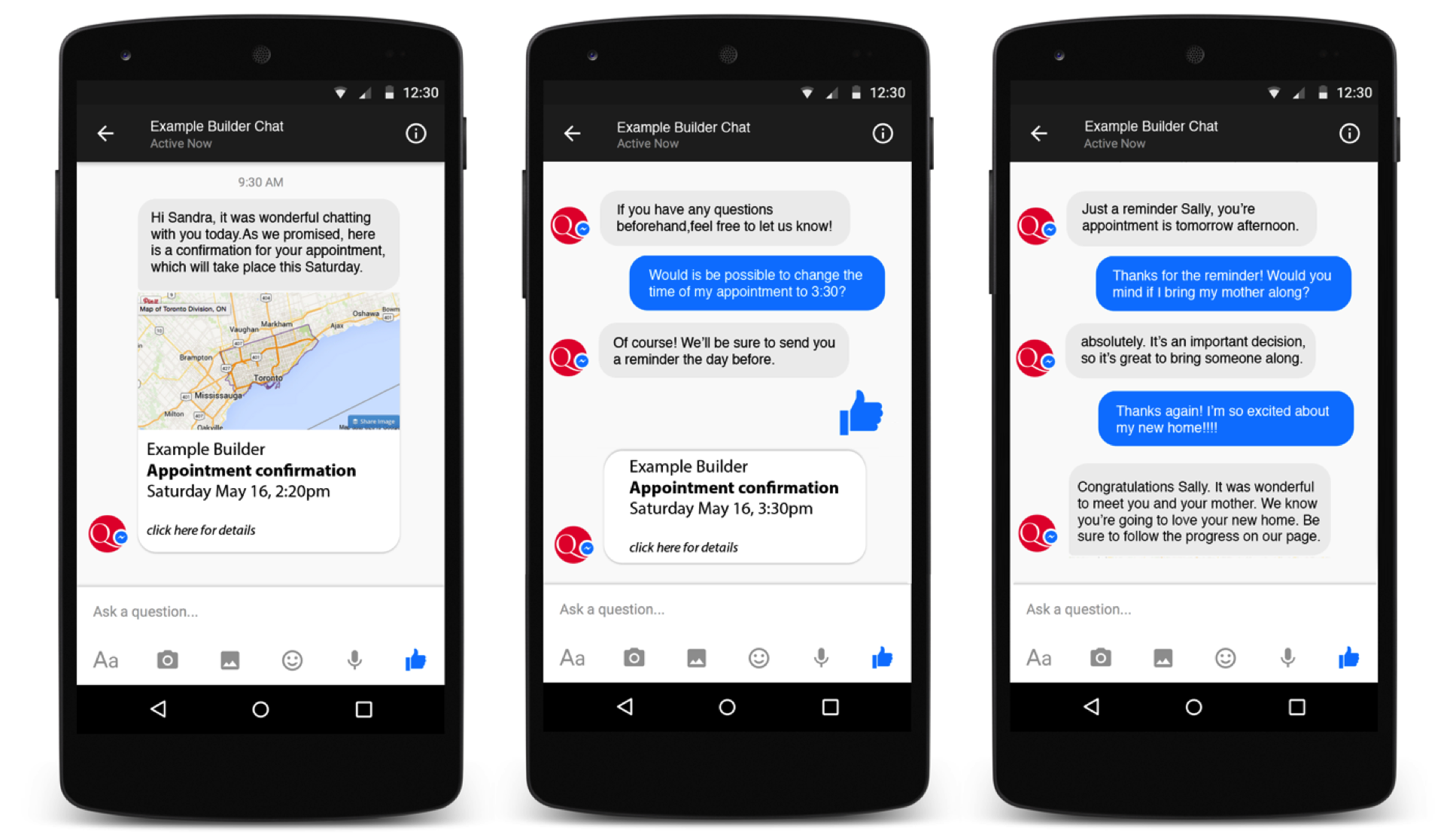
Imagine that you’re a potential homebuyer searching home listings in your area. You come across a new community that you’re instantly in love with, and decide that you’d like more information. You notice a live-chat pop-up and click on it. It asks you for your Facebook info, and after a quick login you’re connected directly with the builder. You ask a number of questions, and receive feedback. Sensing that you’re extremely interested, the builder invites you to book an appointment. They offer you a few available timeslots. You’re not sure if the times work for you, so the builder tells you to simply let them know. Because the website’s chat applet has been using the Facebook messenger platform, the whole conversation is archived on your Facebook, and you’re now connected directly with the builder. Two days later, using your mobile phone, you open up the Facebook app and accept an open appointment time. The conversation is archived, so it’s easy for a representative of the builder to quickly see the message trail – and respond appropriately. The day before your appointment, the builder sends you a message with an easy to read Google map. Below is an example of how an interaction could take place.
Untitled

Unfortunately, this feature isn’t available just yet. Facebook is slowly rolling it out with a small group of large US brands, but a representative recently revealed that we could see a release for all pages/businesses within the next 4 months. It’s very exciting, and has the potential to further personalize the homebuying process – and to create a strong community of engaged buyers. If you’re interested in Messenger for Business, Facebook is currently allowing parties to sign up for updates.

Responsive Web Design Is More Important Than Ever

Untitled

Having a website that is mobile friendly is not a new concept. It’s something that marketers, designers and brands have been aware of for a while now, especially with the sharp – and consistent – rise in the use of mobile/smart devices over the years; however, ignoring or overlooking responsive design is not an option going forward. Google recently announced an update to their algorithm that affects searches made on smart devices. As of April 21st, results will now favour websites deemed “mobile friendly,” giving them higher rankings than websites that are only optimized for desktops and laptops. Considering that roughly 60% of all web traffic takes place on mobile platforms, that’s a big deal.

So what does this mean for marketers? Well, if you manage or build websites that are heavily reliant on search traffic, and you don’t meet the standards set out by Google, you run the risk of having your mobile search ranking, and consequently mobile traffic, drop. A recent study by Portent revealed that 10,000 of the web’s top 25,000 sites actually failed to meet the criteria – that’s a big reality check. There is good news, though: the algorithm is real-time, meaning sites can correct their issues, which can include things like text sizing and link spacing, and recover their former ranking.

Responsive design is something that we’re cognisant of here at BAM when we develop comprehensive online strategies for our clients. With a large portion of users accessing sites as a result of both e-blasts and mobile web searches – especially while on the go – we put emphasis on ensuring a smooth online experience, regardless of where it’s taking place. A great example of a mobile-friendly website is the one we built for our client Sean Mason, which was nominated for Best Website at the 2015 BILD Awards.

The use of smart devices is nowhere close to reaching a plateau – especially if you consider emerging platforms. As new wearable technology such as smart watches continue to push the envelope and transform the way we consume content, marketers will constantly have to adapt in order to stay ahead of the curve.

What Does The Reduction In Bank Of Canada’s Interest Rate Mean For Canadians?

Untitled

Last week, in response to the recent sharp drop in oil prices, The Bank of Canada announced that its interest rate would be dropping to 0.75% – significant considering it’s the second lowest it’s been in the past two decades. It was definitely a surprising move, especially as economists had previously forecasted an increase.

So what exactly does this all mean for Canadians? It could mean lower mortgage rates, which would be particularly exciting for homeowners, and those considering making a purchase. Variable-rate mortgages are determined by the prime interest rate, which is – in turn – linked to the same overnight interest rate that the Bank of Canada just lowered. As one writer for Renter’s Guide noted, people buy payment, not house prices, which I’m sure many people can relate to.

Individuals making payments on other types of debts may see a difference as well. Like variable-rate mortgages, lines of credit and credit card rates (dependant on lender) are generally tied to a bank’s prime interest rate, which is usually tied to the Bank of Canada’s overnight rate. That means borrowers may see their monthly costs come down, depending on whether their bank cuts its prime interest rate; however, some banks have yet to adjust their rates amidst many concerns. Most pressing is the fact that Canada’s household debt-to-income ratio hit a record high 162.6 percent just this past December.

Any downsides? Well some obvious ones that come to mind is our dollar, which fell dramatically against a variety of major currencies as soon as the Bank of Canada made its announcement. That’s bad news for any of you planning any trips south of the border or abroad. Another negative about a lower Canadian dollar is the higher cost of imports such as food from the USA; however, a major benefit of lower Canadian dollar is the potential increase in Canadian exports. Another potential downside to the drop in interest rate is that it could mean bad news for individuals who count on interest generated from traditional savings accounts.

Interest rates have proven to be, if anything, unpredictable. This decrease is looking like it will be a great opportunity for a majority of homeowners and buyers in the interim, but it will be interesting to see how it plays out and affects the real estate market in the long-term.

A Recent BAM Success Story

Sean Mason

At BAM, there’s nothing that makes us happier than helping our clients achieve their bottom line goals – in our minds we are the clients. Working with BAM means we become a part of your team and we do everything we can to champion your brand. So you can imagine how excited we get when we’re able to share successes with everyone.

I’d like to share the recent success story from one of our clients, Sean Mason. He’s an exciting new builder in Barrie who is doing some really innovative things. We’re talking a community of truly green homes. From being ENERGY STAR compliant throughout, to the materials used in the construction and the actual community design, they are homes designed to be healthier for you and your family. BAM has a long history with Sean, spanning seven years. Sean had previously led Mason Homes (his father’s company) to be the first ENERGY STAR standard builder in Canada and has twice won BILD’s Green Builder of the Year award – but this community of smart towns is the first for Sean Homes, which is Sean’s own company.

This past weekend it opened to the public, and we couldn’t be happier with the results. There was a great turnout, and a healthy number of homes sold – to say that Sean Homes was well received would be an understatement.

Marketing Automation Comes To BAM

Untitled

Back in the beginning of August I told you all about the next big thing for our team – marketing automation. To BAM, marketing automation was all about providing registrants and website visitors personalized content based on online behaviours – what they click online, in eblasts, etc. At the time, if you recall, I mentioned how excited we were about the benefits that this type of relationship building creates for our clients.

Well, as of this week, I’m especially happy to report that we’ve deployed our first set of emails – and if you’re registered with Queensville, one might already be in your inbox. Six versions of our first personalized community eblast were created and deployed to registrants based on survey questions they answered during the registration process. We’ll now be able to gather extensive after-the-click tracking on each email so that we can further craft personalized messaging that will speak to the individual interests of the recipients. This is no different than the customized content that sites like Amazon or eBay generate for their customers.

Our newest team member, Zoë Ong, is quarterbacking this new initiative. Zoë, who previously worked at itracMEDIA, a marketing automation firm, is currently in her second week here at BAM. She has a strong background in the field and, when asked, had this to share on the topic:

“Marketing automation helps you target the right people more effectively. It only makes sense to use a user’s interests and browsing habits to deliver meaningful content they want to see.”

BAM is thrilled to have Zoë on the team, and I’m confident that she will help us take our digital thrust to the next level because the stats speak for themselves – 63% of companies that are outgrowing their competitors use marketing automation software. In the end, the real value added is the relationships this type of marketing creates between our clients and potential homebuyers – and we’re excited to be a part of it.

Previous Older Entries Next Newer Entries