Latest Development in the 2012 Ontario Building Code Will Help Ontario’s Builders

As I’ve written before, the new Ontario Building Code will come into effect on January 1, 2012. Thanks to stricter standards, this OBC will ensure homes in Ontario use less energy, reducing emissions and helping homeowners save money.

Brookfield Homes’ Pathways is one of many communities featuring Energy Star-qualified homes.

Admittedly, the new OBC has the potential of becoming somewhat onerous for builders to enforce. It has, after all, up to 10 different compliance packages that pertain to builders in the GTA. They involve many variations in insulation levels in the attic, basement walls, and exterior walls, plus an option to include a heat recovery ventilator depending on the chosen package, as well as an increased furnace’s annual fuel utilization efficiency.

Luckily, things are now simpler. The Ministry of Municipal Affairs and Housing has just published amendments that make it possible for builders to bypass these packages, settling instead for current Energy Star specifications.

In other words, every new home that meets the Energy Star technical requirements will be considered compliant with the energy efficiency requirements for the 2012 OBC. In effect, Energy Star has become the 11th choice for local builders to comply with the new OBC.

This will greatly simplify builders’ lives, making it easier for them to build far more Energy Star-qualified homes while complying with the new OBC. This is why we’ll be calling our clients today to inform them about the new amendments and to encourage them to make their upcoming communities Energy Star-compliant.

This is a good day for green. And with that in mind, I wish you a Merry Christmas and Happy Holidays.

The Origin of Our Name

As Shakespeare’s Juliet famously wondered, what’s in a name?

Although the Bard of Avon implied (or at least Juliet did) that names have little meaning, we marketers know better.

Here at BAM, we spend long hours choosing different names for our clients’ communities. These names need to convey, often in just one word, everything that’s essential to the community. They must embody its spirit. They must be easy to remember. It helps if they’re catchy.

On all accounts, the name of our company does a great job, if I say so myself. (And I have to, since I wouldn’t feel comfortable discussing names we’ve used for our clients.)

BAM

Of course, the fact that Builder Advertising & Marketing happens to form such a short potent acronym is not a coincidence. But that’s not the main reason we use it — the way I see it, BAM works as a name because it’s an onomatopoeia.

Indeed, the word “bam,” which dates from 1772 or thereabout and imitates a sudden loud noise, is “often used interjectionally to indicate a sudden impact or occurrence.” Which is precisely what we like to do for our clients — to create an impact.

In other words, BAM works because it’s an acronym that stands for what we do. It works because it’s short and memorable. Above all, it works because it embodies, better than any other word, the idea of an impact.

I’m often reminded of this when I go to an event and someone greets me with a loud “BAM!” I always think, “Thanks for the free publicity,” even as some passers-by look on, a confused look on their face, probably wondering why somebody shouted “bam” at me.

The Concept of Casual Spreads to New Homes

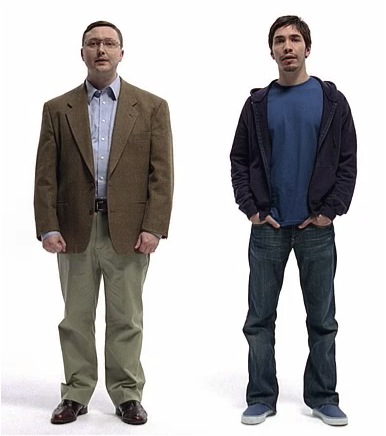
A traditional home vs. a casual home.

Have you seen those Apple vs. PC ads on TV?

As this article that a friend sent me remarks, part of these ads’ success lay in pitting casual (Mac) vs. traditional (PC).

Here’s the kicker: far from being limited to clothes or computers, the appeal of casual has also extended to homes.

This can be seen in today’s prevalence of open-concept spaces and the frequency with which builders use the term “casual living.”

Once the realm of condos, open-concept rooms now abound in detached homes. Gone are stuffy, formal living rooms and rarely used dining rooms. They’ve been replaced with large, family-friendly rooms that you can use for pretty much anything, whether it involves watching TV or eating or playing.

The reasons are twofold. First, 9/11, which reduced travel frequency for most people. Second, the recession, which made people entertain at home more often rather than go out. As a result of these two factors, homeowners now prefer homes better suited for spending quality time inside.

This doesn’t just mean open-concept rooms but also more covered areas in the back and decks for them to host BBQs, blurring the separation between outdoor and indoor living.

(Among our clients alone, Highmark Homes’ The Orchard and Brookfield Homes’ Rosebank by the Lake offer such areas.)

Of course, this isn’t set in stone. Whether you choose to build homes that are traditionally designed or homes with open-concept designs depends to a large degree on location and target demographic.

But you should at least be asking yourself this important question: are you 100% certain that this community’s homebuyers want traditional, separate rooms?

Summary of Changes Introduced in the 2012 Ontario Building Code

Last week, I attended an EnerQuality/BILD course on the new Ontario Building Code (OBC) that will come into effect on January 1, 2012. This blog post is a summary of what I learned.

Please note that this summary refers to low-rise builders operating in southern Ontario.

First, the majority of the changes in the new OBC aim to improve energy efficiency and water management.

Second, builders will be given 10 practical choices of packages on how to comply with the 2012 OBC. Four of these choices appear most practical, meaning they are the simplest as well as the most economical. All four require increased insulation.

So, depending on the package chosen, builders will have to ensure that:

  • the attic’s insulation increases to R50 (from R40),
  • exterior walls’ insulation goes up from R19 to either R22 or R24 (depending on the package chosen),
  • the furnace’s annual fuel utilization efficiency (AFUE) increases from 90% to 92% or 94%, again depending on the package. The heat recovery ventilator (HRV) may or may not be required, depending on the package, and…
  • the insulation of basement walls either stays at R12 or goes up to R20 (depending on the package).

Also, windows will have to be more energy efficient regardless of which package is chosen.

Builders can choose to ignore these compliance paths, provided they build to Energuide 80 (which is what the current  Energy Star stipulates. See my previous blog post).

What are your thoughts on the new OBC and the compliance paths given to builders?

New Marketing Opportunity Presents Itself To Ontario Builders

A window of opportunity.

Today’s ENERGY STAR-rated homes must comply with stricter standards than homes built to the current Ontario Building Code (OBC).

Because of these tough standards, ENERGY STAR homes use substantially less energy, saving homeowners money and helping reduce emissions. These homes are also warmer in the winter, cooler in the summer, and generally more comfortable throughout the year, thanks to reduced noise and draft.

For these reasons, ENERGY STAR homes offer better value. Yet not all builders charge more for these homes. Some make ENERGY STAR a standard option, which allows them to market themselves as green.

Things will change soon, though. On January 1, 2012, a new OBC will come into effect, making all new homes in Ontario meet benchmarks that are even stricter than current ENERGY STAR’s.

In other words, all new Ontario homes will be as energy-efficient and comfortable as today’s ENERGY STAR-rated homes. In effect, they will be the same—minus the official ENERGY STAR certification.

As a result of these changes, ENERGY STAR will too raise its standards so that they once again exceed the OBC’S.

Of course, the new benchmarks won’t be enforced overnight. That would crush builders. Instead, builders will be given a phase-in period. And therein lies a great opportunity for builders.

If they sign up with EnerQuality by June 2012 to register their homes as ENERGY STAR, they will be allowed to sell homes complying with today’s ENERGY STAR standards, which are the same as those of the new OBC. And the builders will be able to do so until 2014, which is when the new ENERGY STAR standards will be enforced.

In other words, whereas homes that comply with the current OBC code cannot be certified as ENERGY STAR, it will soon be possible to sell ordinary homes, built to the new OBC standards, as ENERGY STAR homes. And this will be possible for two and half years.

Expect to see many more ENERGY STAR homes for the next little while.

Previous Older Entries Next Newer Entries