How BAM Is Joining The New Retail Revolution

Empire Communities' Lakeside site plan

Picture your average new homes sales office. A potential homebuyer strolls in, squints at static displays, chooses a design he likes, then walks over to the site plan table, where he again has to locate the homesite.

A cumbersome process if I ever saw one. Worse still, it hasn’t changed much in the last 30 years, despite the technology being there to improve it.

Other industries have woken up. Inspired by Apple, companies like Audi, Nike and Burberry lure store traffic with technology designed to make their experience easier and more pleasant — magical even.

I love this statement by Paul Roth, president of retail at AT&T, as quoted by Adweek: “It’s all about creating interactions rather than just transactions.”

It’s in this spirit that AT&T’s Chicago flagship store boasts an 18-foot video wall equipped with motion-sensory software on which kids can play games. And raindrops patter on a digital rooftop while wind chimes produce something called cyber inharmonic spectra.

I for one strongly believe the new home industry would be wise to join the revolution quietly taking place in the retail world.

That’s why BAM used touchscreens rather than static displays at Empire Communities’ Victory. And why we’re kicking things up a notch with Empire’s Lakeside community, which is opening soon.

In the Lakeside Showroom (doesn’t that sound better than “sales office”?) homebuyers will be able to browse home designs on touchscreens, much like they did at Victory.

More than that, they’ll be able to choose a specific homesite and watch it light up on the site plan (which is also digital).

It’s not just innovative and cool — it’s also helpful for the consumer. And it elevates the client to a status above and beyond every other low-rise builder in the province. Maybe even the country.

The digital revolution is evolving so fast it’s permeating offline territory. Those who ignore it do so at their peril.

Progressive Is In

Two weeks ago at the BILD Awards, I loved seeing so many progressive projects win.

Here’s why.

As I’ve written before, many of today’s consumers have a pent-up craving for fresh new interiors and exterior living. They may not want to live in a condo, but they do appreciate the sleek condo approach — even if they’re moving to a low-rise community in the outskirts of the GTA.

Image

Take our client Highmark Homes, whose community Triumph is opening soon in Whitby. For the first time ever in the region, homebuyers will get a chance to buy a home that combines cutting-edge finishes and contemporary exteriors — all without having to move to expensive Toronto.

What’s more, Triumph features Vanier Park, a 3-acre park billed as the spot for “the young and the young at heart.” We could’ve offered the usual gazebos and trails and so on — and we did. But we also kicked it up a notch and offered a splash pad and a zip line.

And that’s what today’s homebuyer wants — better, newer, more modern, and different — all for as low a price as they can get.

Challenging? Yes. Exciting? Hell yes.

How Two of Our Upcoming Projects Benefit From The Rise Of The Single-Person Household

01 (48)

Single women account for one-third of all new sales at popular condo builder Tridel.

When I began working in the industry, most homebuyers were married and with kids. Over the last few years, however, an increasing amount of singles have been snatching up homes across Canada.

Indeed, only one year ago Stats Canada reported more one-person households than couple households with children for the first time ever, according to a recent Ontario Home Builder magazine article.

The reasons for this are threefold: first, as baby boomers age, many find themselves living alone; second, young people are marrying later; and third, many divorcees are in no hurry to tie the knot again.

Obviously, these new homebuyers are attracted to a different type of home. For one thing, space isn’t as important to them. Instead, they focus on amenities and features and finishes. Practicality matters too — as the OHBA article states, single homebuyers can view a condo, townhouse or small detached home as a stepping stone to something larger, with or without a partner.

This phenomenon, of course, presents a marketing opportunity — one that we’re only too eager to benefit from. Take two communities we’re hard at work on, Ten88 and Villagio.

The former is a condo project in Scarborough featuring a payment program designed to enable renters to purchase their first home. The latter is a smaller, somewhat more traditional community in Maple, Vaughan. In both cases, homebuyers can get one-bedroom units. They also get attractive pricing and finishes that are as sleek as the ones they’d find in a condo. And since our client, Empire Communities, also builds high-rise, it will be that much easier to blur the lines between a typical low-rise community and a high-rise condo one.

Now I turn it over to you: how are you making the most of the rise in single-person households?

This simple organization trick can have a positive impact on your working day

When you run a company called BAM, which aims to create a positive, dramatic impact on our client’s lives, it pays to have in your arsenal a priority management tool that’s as effective as it is simple and quick to implement.

In today’s hectic workplace, this has become a huge topic — a Google search for key words like “task prioritization” and “time management tools” literally pulls up millions of results.

Consider, for example, Dave Allen’s “Getting Things Done” framework, whose adepts seem to be everywhere, and who heap lavish praise on the method. Or how about all the software that promises to help you organize your day and make life easy and effortless?

Yet for all the hype, I find most of these methods too cumbersome to apply to daily life, and certainly to our fast-paced work environment. In particular, I take issue with the amount of time they require to implement, which makes them, at least to my mind, a poor match to BAM’s philosophy (of course, I do realize they may work well for some people).

So how do I organize myself? Which method do I suggest to our employees?

As you might predict, it’s simple and plain and cheap and fast. It’s also, in my opinion, extremely effective.

Untitled

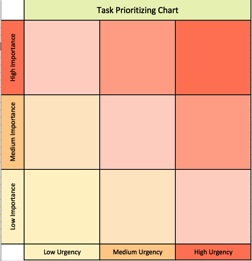
Whether you use an electronic version, a print-out, or (as is often my case) pen and paper, this chart allows you to tackle the important and urgent tasks first. Just put any jobs you have on your plate into the appropriate box and attack the list from the top-right to the bottom-left.

Simple, plain, cheap, and fast. Call me old-fashioned, but this beats fancy software and methodologies any day of the week.

How do you deal with concurrent tasks? How do you manage your daily schedule?

90% shop for new home online!

A study published this week confirms what we’ve been saying all along: consumers’ online experiences are increasingly influencing their home buying activity offline.

According to the report, a whopping 90 percent of homebuyers searched online during the home buying process, with 52 percent choosing that as their first step in the process.

eBAM rocks our client's online world.

For an idea of how we rock our clients’ online world, visit the eBAM section of our website.

Called “The Digital House Hunt: Consumer and Market Trends in Real Estate,” the report includes custom research from the U.S. National Association of Realtors’ 2012 Profile of Home Buyers and Sellers, combined with internal Google data and research.

Particularly interesting to BAM were three findings:

  • First, 31 percent of  home buyers who took action on a real-estate website were aged 25-34, the biggest share of any age group,
  • Second, video played an important role in consumers’ search process, specifically when they wished to find out more about a particular community, tour the inside of a home, or obtain general information,
  • Third, about one-fifth of real estate related searches occurred on mobile devices — a 120 percent year-over-year increase.

These findings confirm that video plays a major role in this online research process. They also confirm that while having an online presence will drive traffic and generate leads for any demographic, it’s especially important in the case of a community targeting younger homebuyers. (However, the data still show people of all ages do go online to research the home buying process.)

This is why we strongly recommend to all our clients that they advertise online and create SEO-optimized websites, as well as an active social media presence. As for video, we aim to revamp our efforts in 2013.

A statement from Patrick Grandinetti, Google’s head of real estate, does a fine job of summarizing the report’s findings — as well as our recommendations for the past few years:

“Online technologies are [increasingly] driving offline behaviors, and home buying is no exception. (…) The real estate industry is smart to target these people where they look for and consume information — for example, through paid search, relevant websites, video environments, and mobile applications.”

Did you read the report? Did any of its findings surprise you in any way?

Previous Older Entries Next Newer Entries