Always Put Yourself in the Buyer’s Shoes

Creating a new campaign is a very exciting process. I’m sure we all agree about that. Nothing compares with the brainstorming, the tossing of ideas, the criticisms, the jokes that happen when you work hard with your team.

One of the challenges that makes this process so fun is trying to present every campaign in a new, thrilling manner.

Treetops is a new home community in Alliston, Ontario

Take empty nesters. Their kids have moved out. They’re either retired or close to it. Arguably, their outlook of life is not as eager or ambitious as when they became parents or bought their first home.

This is probably why many campaigns aimed at the empty-nester market seem quiet and discreet and almost crusty. Thinking the campaign should mirror what’s perceived as the demographics’ lifestyle, many marketers come up with campaigns that are at best virtually undistinguishable from one another, and at worst just plain ineffective.

Likewise, when it comes to first-time homeowners, many marketers try to conjure a vibrant, sexy lifestyle that they believe reflects the one their target demographic has (or wants to have).

What do consumers want?

All too often we forget in the advertising and marketing industries that people don’t think of campaigns. In fact, they don’t even care for campaigns. They just think about lifestyles.

Yet many new home community campaigns barely touch on lifestyle, promoting instead features and floorplans. Of the few that do actively sell lifestyle, most end up looking generic and uninspired.

So, the first step towards making your target consumer choose the lifestyle you’re promoting is simply to put yourself in their shoes — to look at things from their perspective.

Sometimes, if you work hard enough, this can help you find a lifestyle that your target audience didn’t even know was possible, one that excites them and makes them happy.

In the case of the empty-nester market, our campaign for the Port Hope Golf & Country Club did away with tradition and painted an optimistic image, active image, featuring unexpected touches such as touchscreens in the sales office and musical lyrics peppered on the website.

As a result, Port Hope Golf & Country buyers felt empowered to live an active lifestyle, to understand and appreciate technology, and to feel optimistic about the years ahead.

Concerning first-time homeowners, our latest campaign, Treetops, also tries to break with tradition. The community itself will be extraordinary, featuring 1,800 semis and detached homes in Alliston, Ontario, all of them adjacent to the Nottawasaga Inn and Resort, which offers a stunning array of activities, and is surrounded by 50 acres of forest and parks.

That said, none of the aforementioned are the reasons why they’ll buy a Treetops home — they’ll do it because they want to partake in the lifestyle reflected in this video. It’s a lifestyle that’s not just about being active, but also about happiness and romance and joy. A lifestyle where a touch of the whimsical is present every day, and where life extends beyond your backyard into a fantastic community.

How do we make that happen? For starters, by putting ourselves in the consumers’ shoes.

Should Companies Set New Year’s Resolutions?

It’s easy enough to mock New Year’s resolutions. Having committed to them half-heartedly, many people quit right at the beginning, or halfway through at best.

Indeed, according to this Forbes article, half the New Year’s resolutions are out the window by July. Only about 10 percent of us maintain our resolve by the time the following New Year’s rolls around.

Worst of all, many of us go on to make the same resolution next year, telling ourselves that this is it; this time around we will stick to it.

Does this make New Year’s resolutions pointless?

2011 Calendar Cover, by Julia Louie

Was it the best it could be?

Of course, asking this very question raises a larger question: is setting goals pointless?

In my view, the problem lies not with resolutions themselves, but in failing to plan ahead, and in setting too ambitious goals that we’re not fully committed to in the first place.

I am a strong believer in planning ahead. I believe in mapping out the road ahead and in setting ambitious (yet achievable) goals. And I believe this is important not just on a personal level, but also on a professional level.

I also happen to like the idea of beginning the New Year with a clean slate and a clear direction in my mind.

So to avoid wandering around, and to make 2012 the best year our company has ever had, I have outlined what our goals for the New Year are. I will also discuss them with my team, which not only opens up the field for discussion, but also amounts to making my resolutions (somewhat) public. (Incidentally, this has been proven to help people accomplish their goals.)

Do you believe in resolutions and goals, whether at the beginning of the New Year or at a different time? Do you set them at a personal level, professional level, or both? Do you share them publicly?

Don’t Spend Too Much Time in the Boardroom

Dirty Hands

It pays to get ‘em dirty.

Driving back to the office from a client’s construction site a few days ago, an employee whom I’d taken along for the ride said he was surprised I’d get out of the car to straighten a crooked sign.

“I’m sure most other company presidents would just get somebody else to fix it later,” added the employee.

I don’t know that most other presidents would do that, but I’m pretty sure a majority would. And that’s unfortunate.

I’m not even talking about the sheer pleasure we should all derive from rolling our sleeves up — the pleasure we should all experience to see homes being built, little by little, or the pleasure of knowing these homes are a family’s dream becoming reality, one that will soon see the whole family spend quality time in the kitchen after a long day.

Rather, I’m talking about common sense. I’m talking about good business practice.

See, it pays to drive to the construction site. It pays to roll your sleeves up and get your hands dirty. It pays to know what things look like and smell like to the consumer, and not just from the vantage point of your faraway office. It pays to fix that crooked sign yourself.

Consider another example. On our way to this construction site, we drove past a competitor’s sign announcing a new home community.

At least, that’s what I think it was, for the sign was much too cramped, and its font size much too small, for anyone to really know what it was about.

A sign like that can only be the product of a boardroom meeting — one whose members didn’t bother to set foot where the sign would be located.

The price? A sign that no one can read. A wasted opportunity. Money thrown into the wind.

Get your hands dirty. It pays to do so — in more than one way.

The Concept of Casual Spreads to New Homes

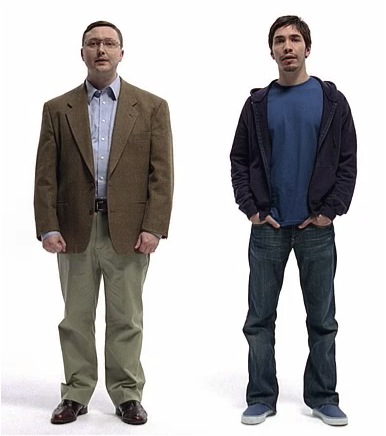
A traditional home vs. a casual home.

Have you seen those Apple vs. PC ads on TV?

As this article that a friend sent me remarks, part of these ads’ success lay in pitting casual (Mac) vs. traditional (PC).

Here’s the kicker: far from being limited to clothes or computers, the appeal of casual has also extended to homes.

This can be seen in today’s prevalence of open-concept spaces and the frequency with which builders use the term “casual living.”

Once the realm of condos, open-concept rooms now abound in detached homes. Gone are stuffy, formal living rooms and rarely used dining rooms. They’ve been replaced with large, family-friendly rooms that you can use for pretty much anything, whether it involves watching TV or eating or playing.

The reasons are twofold. First, 9/11, which reduced travel frequency for most people. Second, the recession, which made people entertain at home more often rather than go out. As a result of these two factors, homeowners now prefer homes better suited for spending quality time inside.

This doesn’t just mean open-concept rooms but also more covered areas in the back and decks for them to host BBQs, blurring the separation between outdoor and indoor living.

(Among our clients alone, Highmark Homes’ The Orchard and Brookfield Homes’ Rosebank by the Lake offer such areas.)

Of course, this isn’t set in stone. Whether you choose to build homes that are traditionally designed or homes with open-concept designs depends to a large degree on location and target demographic.

But you should at least be asking yourself this important question: are you 100% certain that this community’s homebuyers want traditional, separate rooms?

BAM Creates Another Green Brand

Mona Lisa, Louvre, Paris

Great art alone doesn’t equal great advertising.

Some advertising agencies have great creative. They produce stunning graphics and appealing copy and catchy slogans.

But that’s all they do.

At BAM, we do our best not just to excel in terms of creative work, but to help develop each client’s marketing strategy.

Why? Because we believe clients deserve more than just great creative.

Take Lakeview, our latest client. Lakeview is developing a new 400-home community in the town of Shelburne. Called Greenbrook Village, this new community will feature bungalows and two-storey homes from $249,990 on large, traditional 40-foot homesites.

Attractive as the package was, we figured it could use a little something extra. Something guaranteed to entice potential homebuyers. Something that’s not only perceived as good, but also helps homeowners save money.

On all counts, nothing beats a green brand.

Having already developed award-nominated green brands ECO² (for Empire), Green for Life (for Mason Homes), and Green Saver (for Brookfield Homes), we know from experience that they can only benefit builders. Green communities help consumers live a healthier lifestyle and save money, and of course the world benefits too. By promoting these advantages to consumers, we help our clients sell more homes,all while doing well for the earth.

With this is mind, BAM will repackage the Greenbrook Village community as a green community—one that’ll be built to EnergyStar rating, offering homeowners energy savings and home comfort unlike anything Lakeview has offered before.

Previous Older Entries Next Newer Entries