What do Technologists Have in Common With Marketers?

This week I read about a new way to save water — while you shower.

The Reveeco EcoVéa recycling shower analyses whether water is dirty (which it then discards) or clean (which it filters, treats, and reuses). For a 10-minute shower, the EcoVéa can save up to 80% on both water and energy.

(Typically, you produce dirty water when you soap and clean water when you just relax in the shower. Clean water is also produced when you turn the shower on and let water run for a few minutes before you jump in.)

I also read about a new smart meter, designed by Tony Fadell, a former Apple employee who once worked in the iPod development team.

Name's Nest, not HAL.

In typical Apple fashion, this new smart meter, dubbed Nest, is supposedly simple to use. It also “learns” from your behaviour to help you save money, increasing or decreasing temperatures when your home is empty or when you return home from work, among other features.

(As a side note, I was most interested about this device as some of our clients already use an innovative meter called the Cent-A-Meter that displays the real-time usage of electricity on a portable LCD monitor.)

Why do I mention these innovations?

Because they prove two important points.

First, technology isn’t just going to introduce improvements on big, expensive things like solar roof panels and cars. It’s going to affect smaller, cheaper things, too.

In fact, when you think about it, don’t you find it surprising that no one had improved upon shower technology—or home energy monitors—for such a long time?

Second, technology will always reinvent things—even those we take for granted. And in doing so, it will always find ways to save energy and create products that are more efficient. Today’s latest product is already dated.

In a way, technologists are just like marketers—they’re always trying to find solutions.

Have you come across a new piece of equipment that caught your eye?

BAM Creates Another Green Brand

Mona Lisa, Louvre, Paris

Great art alone doesn’t equal great advertising.

Some advertising agencies have great creative. They produce stunning graphics and appealing copy and catchy slogans.

But that’s all they do.

At BAM, we do our best not just to excel in terms of creative work, but to help develop each client’s marketing strategy.

Why? Because we believe clients deserve more than just great creative.

Take Lakeview, our latest client. Lakeview is developing a new 400-home community in the town of Shelburne. Called Greenbrook Village, this new community will feature bungalows and two-storey homes from $249,990 on large, traditional 40-foot homesites.

Attractive as the package was, we figured it could use a little something extra. Something guaranteed to entice potential homebuyers. Something that’s not only perceived as good, but also helps homeowners save money.

On all counts, nothing beats a green brand.

Having already developed award-nominated green brands ECO² (for Empire), Green for Life (for Mason Homes), and Green Saver (for Brookfield Homes), we know from experience that they can only benefit builders. Green communities help consumers live a healthier lifestyle and save money, and of course the world benefits too. By promoting these advantages to consumers, we help our clients sell more homes,all while doing well for the earth.

With this is mind, BAM will repackage the Greenbrook Village community as a green community—one that’ll be built to EnergyStar rating, offering homeowners energy savings and home comfort unlike anything Lakeview has offered before.

How Much Will Facebook Change Its Business Products in Response to Google+?

Facebook

Things just got a little easier.

Last week, I blogged about Google+ and why marketers should embrace it.  I’m not alone: this site recommended businesses learn Google+, this one quoted social media expert Chris Brogan as saying that the “new network will be a powerful tool for business owners to connect with customers online,” and a third site brought up some of the same points I made in my blog post.

With such an interest in the new social network, I wasn’t surprised to read that Facebook just revamped its privacy settings, making it easier for users to control who sees what and whether they were tagged in a picture (which they can then untag), among other welcome changes.

(Facebook representatives said the changes were introduced because of user feedback, but I suspect it felt compelled to act because of Google+ and its much-praised privacy controls.)

Of course, these changes are aimed at the individual users and not at the Facebook pages that marketers create for our clients. But with so many voices suggesting marketers and businesses get familiar with Google+, I for one wouldn’t be surprised to see revamped settings for Facebook pages in the next few months.

What Facebook features would you like to see changed?

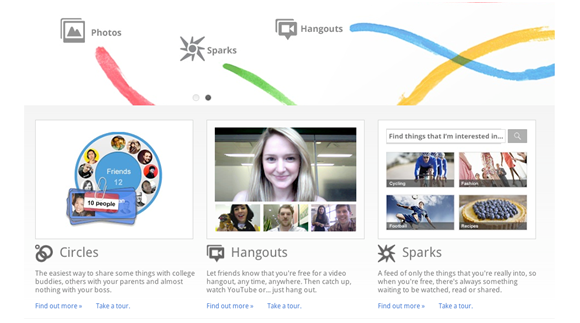
Google+ and Why It’s Good for Marketers


There’s a new kid on the block. That kid is Google+, and some people don’t want him around.

Of course, on most fronts, Google is far from new. It’s the most popular search engine worldwide (although perhaps not the most effective), and has also dominated the online environment with its email service, blogging platform, and other products.­­

On the social media front, however, Google let Facebook and Twitter slip ahead. And in a future where social media may greatly influence search engine results, Google couldn’t just let its competitors take over, especially not after Facebook joined forces with Microsoft’s Bing search engine.

The result is Google+, a new social network that prompted many people to utter a weary, “Really? Another social media network?”

I can see where these people are coming from—provided they’re personal users. But businesses? They should jump on the bandwagon as soon as they get a chance.

(Google+ business accounts are not out yet, but reports indicate they may be released soon enough.)

Here’s why businesses and marketers, whether small or large, should keep an eye on Google+:

            What does this mean? Being among the first businesses to have a Google+ account will help you reach a fairly new audience that’s not bombarded   with competing messages, at least not on that one platform.

            What does this mean? Facebook’s analytics leave a lot to be desired, in my opinion. If Google+ manages to provide us marketers with analytics that give us more information about our followers without putting them off, we’ll be able to offer targeted messages that do a better of job of appealing to our audience.

  • Tighter integration with YouTube. No surprise here, since Google owns YouTube. I’ve always thought many marketers need to do a better job of exploiting YouTube. Google+ should make this easier.

What does this mean? People will be more likely to comment on and share a video they like, successfully spreading word about it, if they are on a more tightly integrated platform. This isn’t the case now—if someone likes a video on YouTube, they have to log in to Facebook to share it with their friends. Despite this, most of the traffic goes back to YouTube. With Google+, the traffic would stay on the same network, making it more likely for videos to be shared and liked.

For these reasons, we at BAM plan on keeping an eye on Google+ news.

What’s your take on Google+? Do you plan on opening an account when they’re released?

Video: A Powerful Tool in BAM’s Arsenal

We’ll fill the house for you.

What is that Chinese saying again? The one about a picture being worth a 1,000 words?

I wonder what they would say about a moving picture.

Moving images have always been extremely powerful. When early movie theatre audiences watched a clip of a train charging toward the camera, they scrambled out of the theatre, thinking their lives were in danger.

Today’s audiences, for all their sophistication, continue to respond in a visceral manner to moving images (which I’ll refer to as “video” from now on).

Thankfully, video is no longer limited to TV. In fact, TV-viewing rates keep decreasing while people turn to the likes of YouTube, Netflix, and iTunes on their computers and handheld devices.

This is great for us marketers. Spreading video over the Internet is incredibly cheaper than on TV. It also allows us to track views and to target different audiences with more precision.

And thanks to modern technology, making video is also far cheaper than it has ever been.

We at BAM like to make the most of technology and current trends to help our clients market their product. And video is a great way of doing that. When your potential homebuyers watch their future home on a screen, for example in a video tour of a model home, or when they hear and see people offering a testimonial, they suddenly become more receptive to your message. Videos can give you a face on your website, engage people reading your emails, and lend a personal touch to your social media presences.

Videos, in one word, are the ultimate resource to establish an emotional connection with your audience.

This isn’t just an opinion. Video content can boost your website’s SEO, which ultimately reflects on people’s increased interest in your content.

BAM can make you a punchy video that will deliver a big impact for a low cost. We can provide a whole range of videos, from quick web-based videos to super produced professional videos.

Check out our Video Portfolio on our website, or watch two of our latest creations here:

Previous Older Entries Next Newer Entries