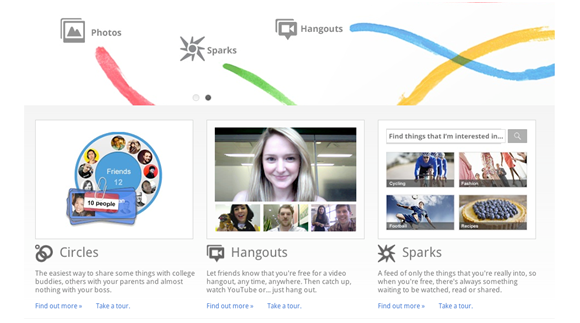
Google+ and Why It’s Good for Marketers


There’s a new kid on the block. That kid is Google+, and some people don’t want him around.

Of course, on most fronts, Google is far from new. It’s the most popular search engine worldwide (although perhaps not the most effective), and has also dominated the online environment with its email service, blogging platform, and other products.­­

On the social media front, however, Google let Facebook and Twitter slip ahead. And in a future where social media may greatly influence search engine results, Google couldn’t just let its competitors take over, especially not after Facebook joined forces with Microsoft’s Bing search engine.

The result is Google+, a new social network that prompted many people to utter a weary, “Really? Another social media network?”

I can see where these people are coming from—provided they’re personal users. But businesses? They should jump on the bandwagon as soon as they get a chance.

(Google+ business accounts are not out yet, but reports indicate they may be released soon enough.)

Here’s why businesses and marketers, whether small or large, should keep an eye on Google+:

            What does this mean? Being among the first businesses to have a Google+ account will help you reach a fairly new audience that’s not bombarded   with competing messages, at least not on that one platform.

            What does this mean? Facebook’s analytics leave a lot to be desired, in my opinion. If Google+ manages to provide us marketers with analytics that give us more information about our followers without putting them off, we’ll be able to offer targeted messages that do a better of job of appealing to our audience.

  • Tighter integration with YouTube. No surprise here, since Google owns YouTube. I’ve always thought many marketers need to do a better job of exploiting YouTube. Google+ should make this easier.

What does this mean? People will be more likely to comment on and share a video they like, successfully spreading word about it, if they are on a more tightly integrated platform. This isn’t the case now—if someone likes a video on YouTube, they have to log in to Facebook to share it with their friends. Despite this, most of the traffic goes back to YouTube. With Google+, the traffic would stay on the same network, making it more likely for videos to be shared and liked.

For these reasons, we at BAM plan on keeping an eye on Google+ news.

What’s your take on Google+? Do you plan on opening an account when they’re released?

Are You A Blindfolded Home Buyer?

she burns

Thanks to recent press coverage and social media campaigns, you’re probably well aware of the lack of competition in our communications industry, which is one of the most expensive in the world.

But you may not be aware of a recent revolution in another industry, despite the fact that changes in this industry have far more of an impact on your pocket than any cell phone bill.

I’m referring to the real estate industry, which is undergoing important changes that can affect the way you buy your home. Most of these changes are good for you—provided you know of them.

If you don’t, and if you insist on using a real estate agent, you risk signing away important rights. You also risk disclosing personal information and paying more money than you should.

When the time comes for you to buy your resale home, I want you to be able to make a well-informed decision, one that will let you keep more of your hard-earned dollars where they belong—in your pocket.

This is why I have blogged before about the exclusive representation agreements that real estate agents try to get homebuyers to sign. I have also blogged about the federal Competition Bureau when it opened up the MLS system to homesellers without them having to pay huge commission rates to real estate agents.

Today I’d like to direct your attention again to Ellen Roseman’s latest column for the Toronto Star. In it, Ms. Roseman answers to many FAQs about a homebuyer’s relationship with an agent.

For example: in terms of buying a resale MLS home, do you know the difference between being a “client” and being a “customer”? Do you know if you really have to sign exclusive contracts with a real estate agent?

In my experience, a lot of people don’t know the answers to these questions. And that’s just the way many real estate agents like it.

Realtors & Buyers’ Agreements

This week, I read an article in the Toronto Star about the exclusive representation agreements that real estate agents try to get new home buyers to sign with them. Agents lock people looking for a new home into an exclusive relationship with them, so that they will have to pay commission to the agent whether or not that agent finds them their new home. Worse, agents are trying to get buyers to sign these agreements in sneaky ways – not explaining the paperwork they’re pushing in front of their clients, and not letting people get out of the deal when they realize with shock what they’ve agreed to.

I blogged about this issue back in November 2010, and it’s still a big issue today.

Luckily our current Commissioner of the Competition Bureau, Melanie Aitken, is here to help. Aitken is a hero for Canada’s consumers, as many articles have noted. Part of the reason this problems is happening is that Aitken opened up access to the MLS to low-commissioned firms and no-fee companies, to give consumers more choice and so that homeowners wouldn’t have to pay high commissions. Aitken eliminated the barrier to entry, made MLS available to everyone, and made it easier for homeowners to sell their own homes. But now the high-fee brokers are trying to keep control of the market. They want to convince you that you need a real estate agent to find your dream home. The Canadian Real Estate Association recently launched an ad campaign that uses humour and fairy tale imagery to keep you in their grip and keep that 6% in their pockets. Since you as a consumer may not want to pay that high commission, real estate agents are now actually coercing people into signing these exclusive relationship agreements. This is manipulative and the type of behaviour that Melanie Aitken is fighting so hard to eliminate.

Next up, Aitken is going after credit card companies, trying to stop them from charging such high interest rates, which are non-competitive, usurious rates. Big changes are coming soon to credit card rules in Canada. Aitken is single handedly spearheading all these initiatives, so big kudos to her, and remember: If you’re considering buying a resale home, beware! Real estate agents are not always acting in your best interests.

Why You Should Be On Facebook and Twitter

Perhaps you think Facebook and Twitter are for young people. Or that it’s just people chatting about inane things like what they’re making for breakfast or which movie they’re watching. Sure, there’s some of that, but for the most part, if you link up with people in your field, they’re great venues for networking and sharing ideas.

But don’t just hop on board and then abandon your accounts. These social media sites beg you to engage on a somewhat regular basis. But don’t worry, you’ll be rewarded: you’ll be introduced to new people and ideas, learn about events you wouldn’t otherwise know about, and so much more.

Many people lump Facebook and Twitter together, but they’re not the same and shouldn’t be treated as such.

Facebook is a place to engage in conversation while still being able to promote yourself. While you can reach out to other people and businesses, this is more of a closed-circle than Twitter (Note: If you’re going to do business on Facebook, be sure to create both a personal profile and a professional page. That way, you’re not sharing personal information on your business page and vice versa).

Twitter provides short texts that often include clickable links that are visible to the public. You only have 140 characters per “tweet” so you have to really pack your message with punch in very few words. The most exciting feature of Twitter is that because it’s an open circle, your reach is much, much wider (think of that old shampoo commercial, “And they told 2 friends and so on, and so on…”).

If you are serious about your business, then you should get serious about Facebook and Twitter.

Check out BAM on Facebook and follow me on Twitter – @JohnAmardeil.

The Art of Perception

The way we act is because of the way we perceive things.

Have you and a friend ever looked at the same thing, but taken away two very different ideas of what it was?

The Spinning Dancer is just one example of how people can be certain of what they’ve seen, yet there is actually more than one way to look at it (if you stare long enough at the dancer, you may see her rotate the opposite way).

BAM is in the business of creating/enhancing customers’ perceptions of our clients’ offerings. The way you interpret a website we’ve designed (see below), for example, will depend upon many factors – your experiences, upbringing, influences, education, even your mood.

That’s why we work hard to create work that not only stands out, but that really represents our clients and the best they have to offer. We try to embody our clients’ products, philosophies, and the people behind it all. Then we construct a detailed plan of how to approach the market: Do we use drawings or photographs? What style of renderings? Should we use colours which evoke comfort and warmth, or excitement and energy? Do people look mostly left or right on their computer screen?

Since, as they say, “perception is reality,” we always try to put our clients in the best light possible so that customers will see them in the positive spotlight they deserve.

Previous Older Entries Next Newer Entries