The Building Industry Loses A Friend

Last Thursday night was supposed to be a good night.

Not only did the OHBA Awards ceremony take place, but also one of our clients won an award.

Moreover, my good friend BILD CEO Stephen Dupuis received the inaugural David Horton Lifetime Leadership Award of Excellence, which he reacted to very emotionally, given that David Horton was a friend of his who recently passed away.

But the night’s success was overshadowed by what happened next. Because on Friday morning, I learned that Stephen had passed away sometime after leaving the OHBA Award ceremony. He was 52.

I knew Stephen for a long time. He had an impressive resume. After working for the Association of Municipalities of Ontario and the Ontario Ministry of Municipal Affairs, he joined in 1988 what would later become BILD. He also wrote a column for the Toronto Star and worked with Habitat for Humanity to create affordable housing for all.

What was the reason for this impressive resume? It wasn’t just hard work. In fact, I’m not sure any of it felt like work to him.

Put plain and simple, Stephen excelled at what he did because he loved what he did. And he loved helping people fulfill the dream of having a home. Some of us may forget that’s what it’s all about. But not Stephen.

His passion, his humour, his contagious laughter, and his sense of respect ensured he had many friends in the industry. I am proud to have been one of them, and I join them and his wife Linda and his children Kendall and Carson in mourning the loss of a great man.

New Marketing Opportunity Presents Itself To Ontario Builders

A window of opportunity.

Today’s ENERGY STAR-rated homes must comply with stricter standards than homes built to the current Ontario Building Code (OBC).

Because of these tough standards, ENERGY STAR homes use substantially less energy, saving homeowners money and helping reduce emissions. These homes are also warmer in the winter, cooler in the summer, and generally more comfortable throughout the year, thanks to reduced noise and draft.

For these reasons, ENERGY STAR homes offer better value. Yet not all builders charge more for these homes. Some make ENERGY STAR a standard option, which allows them to market themselves as green.

Things will change soon, though. On January 1, 2012, a new OBC will come into effect, making all new homes in Ontario meet benchmarks that are even stricter than current ENERGY STAR’s.

In other words, all new Ontario homes will be as energy-efficient and comfortable as today’s ENERGY STAR-rated homes. In effect, they will be the same—minus the official ENERGY STAR certification.

As a result of these changes, ENERGY STAR will too raise its standards so that they once again exceed the OBC’S.

Of course, the new benchmarks won’t be enforced overnight. That would crush builders. Instead, builders will be given a phase-in period. And therein lies a great opportunity for builders.

If they sign up with EnerQuality by June 2012 to register their homes as ENERGY STAR, they will be allowed to sell homes complying with today’s ENERGY STAR standards, which are the same as those of the new OBC. And the builders will be able to do so until 2014, which is when the new ENERGY STAR standards will be enforced.

In other words, whereas homes that comply with the current OBC code cannot be certified as ENERGY STAR, it will soon be possible to sell ordinary homes, built to the new OBC standards, as ENERGY STAR homes. And this will be possible for two and half years.

Expect to see many more ENERGY STAR homes for the next little while.

BAM Creates Another Green Brand

Mona Lisa, Louvre, Paris

Great art alone doesn’t equal great advertising.

Some advertising agencies have great creative. They produce stunning graphics and appealing copy and catchy slogans.

But that’s all they do.

At BAM, we do our best not just to excel in terms of creative work, but to help develop each client’s marketing strategy.

Why? Because we believe clients deserve more than just great creative.

Take Lakeview, our latest client. Lakeview is developing a new 400-home community in the town of Shelburne. Called Greenbrook Village, this new community will feature bungalows and two-storey homes from $249,990 on large, traditional 40-foot homesites.

Attractive as the package was, we figured it could use a little something extra. Something guaranteed to entice potential homebuyers. Something that’s not only perceived as good, but also helps homeowners save money.

On all counts, nothing beats a green brand.

Having already developed award-nominated green brands ECO² (for Empire), Green for Life (for Mason Homes), and Green Saver (for Brookfield Homes), we know from experience that they can only benefit builders. Green communities help consumers live a healthier lifestyle and save money, and of course the world benefits too. By promoting these advantages to consumers, we help our clients sell more homes,all while doing well for the earth.

With this is mind, BAM will repackage the Greenbrook Village community as a green community—one that’ll be built to EnergyStar rating, offering homeowners energy savings and home comfort unlike anything Lakeview has offered before.

How Much Will Facebook Change Its Business Products in Response to Google+?

Facebook

Things just got a little easier.

Last week, I blogged about Google+ and why marketers should embrace it.  I’m not alone: this site recommended businesses learn Google+, this one quoted social media expert Chris Brogan as saying that the “new network will be a powerful tool for business owners to connect with customers online,” and a third site brought up some of the same points I made in my blog post.

With such an interest in the new social network, I wasn’t surprised to read that Facebook just revamped its privacy settings, making it easier for users to control who sees what and whether they were tagged in a picture (which they can then untag), among other welcome changes.

(Facebook representatives said the changes were introduced because of user feedback, but I suspect it felt compelled to act because of Google+ and its much-praised privacy controls.)

Of course, these changes are aimed at the individual users and not at the Facebook pages that marketers create for our clients. But with so many voices suggesting marketers and businesses get familiar with Google+, I for one wouldn’t be surprised to see revamped settings for Facebook pages in the next few months.

What Facebook features would you like to see changed?

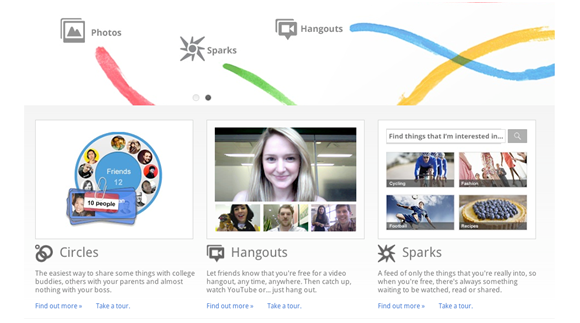
Google+ and Why It’s Good for Marketers


There’s a new kid on the block. That kid is Google+, and some people don’t want him around.

Of course, on most fronts, Google is far from new. It’s the most popular search engine worldwide (although perhaps not the most effective), and has also dominated the online environment with its email service, blogging platform, and other products.­­

On the social media front, however, Google let Facebook and Twitter slip ahead. And in a future where social media may greatly influence search engine results, Google couldn’t just let its competitors take over, especially not after Facebook joined forces with Microsoft’s Bing search engine.

The result is Google+, a new social network that prompted many people to utter a weary, “Really? Another social media network?”

I can see where these people are coming from—provided they’re personal users. But businesses? They should jump on the bandwagon as soon as they get a chance.

(Google+ business accounts are not out yet, but reports indicate they may be released soon enough.)

Here’s why businesses and marketers, whether small or large, should keep an eye on Google+:

            What does this mean? Being among the first businesses to have a Google+ account will help you reach a fairly new audience that’s not bombarded   with competing messages, at least not on that one platform.

            What does this mean? Facebook’s analytics leave a lot to be desired, in my opinion. If Google+ manages to provide us marketers with analytics that give us more information about our followers without putting them off, we’ll be able to offer targeted messages that do a better of job of appealing to our audience.

  • Tighter integration with YouTube. No surprise here, since Google owns YouTube. I’ve always thought many marketers need to do a better job of exploiting YouTube. Google+ should make this easier.

What does this mean? People will be more likely to comment on and share a video they like, successfully spreading word about it, if they are on a more tightly integrated platform. This isn’t the case now—if someone likes a video on YouTube, they have to log in to Facebook to share it with their friends. Despite this, most of the traffic goes back to YouTube. With Google+, the traffic would stay on the same network, making it more likely for videos to be shared and liked.

For these reasons, we at BAM plan on keeping an eye on Google+ news.

What’s your take on Google+? Do you plan on opening an account when they’re released?

Previous Older Entries Next Newer Entries