The Real Reasons Why Mississauga Now Embraces New Urbanism

Mississauga and TTC stop here

Not very pedestrian-friendly.

Hazel McCallion, the long-time Mississauga mayor, has had a change of heart.

According to a recent Globe and Mail article, the same Mayor who “presided over a proliferation of cookie-cutter subdivisions” now champions intensification, pedestrian-friendly streets, and integrated transit.

And to prove she’s a true convert to New Urbanism,  the Mayor just inaugurated a new public square and opened a new Sheridan College campus. She also says she’s working hard to build a Convention Centre in downtown Mississauga within the next 10 years, as well as a new stadium, a larger museum, and a larger art gallery.

More to the point, the Mayor also wants to make Mississauga a pedestrian-friendly city and to host architectural contests for all future downtown buildings.

To me, the most interesting part in the article came when the Mayor was asked why she’s doing all this only now rather than when the core started building up.

To answer the question, Ms. McCallion implied landowners and developers were responsible. Then she added that the city needed more control over site plans.

Whether landowners and developers are responsible or not for the suburban feel of Mississauga, its lack of street life, and its wide bustling roads, I think the real reasons why the Mayor now waves the New Urbanism flag are:

  • All the greenfields have already been consumed.
  • Mississauga needs revenue from development changes.
  • Smart Growth legislation is forcing intensification and redevelopment on Mississauga and all municipalities.
  • The city will get more revenue from property taxes.

Read the article here.  As always, I welcome your thoughts and feedback.

Have Canadians Had Enough Of Big Government?

If only he  could watch us now.

If only he could watch us now.

A recent National Post article had me thinking about the increasing differences between the Canada I grew up in and Canada today. Back when I was younger, people loved our then-Prime Minister Pierre Trudeau. Trudeau was righteous. Trudeau believed in big government. Trudeau believed in social care and in a just society and in protecting those who were discriminated against.

He believed, in other words, that the role of the state was to look after people, and he spent a lot of money seeing to it.

No wonder, then, that immigrants and minority members loved him. Not that they were the only ones—most Canadians seemed to revere Trudeau and what he stood for.

Fast-forward thirty years. We have a majority Tory government, and the city of Toronto, long a Liberal stronghold, just elected itself a major who, economically at least, seems to stand opposite to most things Trudeau held dear.

As if that weren’t enough of a drastic change, harsh Ontario PC leader Tim Hudak looks set to win October’s elections.

Have Canadians changed that much? Have we stopped caring for others?

Or have we simply, like the National Post article suggests, come to see the Liberal party as foreign to our beliefs? Have we had enough of politicians losing our manufacturing or increasing energy costs? (Dalton McGuinty did both.) Have we had enough of the government paying high salaries to its employees, of which there seemed to an increasing number, especially in Toronto in the days of David Miller?

Have we, in short, had enough of Big Government?

The numbers justify this possibility. According to the annual Barometer survey released Wednesday by the Manning Centre for Building Democracy, Canadians now prefer to be seen as individuals rather than as members of an identity group. They also profess to believe the government’s role is to support individual initiatives first rather than always trying to find its own solutions, and that the government should focus on creating equality of opportunity rather than trying to engineer the equality of results.

In other words, many Canadians seem to be telling the government, Leave us alone. We don’t trust you anymore. We will work hard and we will only need you to step in to lend an occasional hand when it’s really needed.

It’s no coincidence then that the Tories run on prisons, jets, police, but also on telling us what to do far less often. They run on the premise that they will empower people to let them make their own decisions—be they good or bad.

So, is this change in Canadians’ mentality good for us marketers and builders?

Sure, it might mean lower taxes and reduced operating costs. But it could also be bad news. For example, conservative governments are less likely to spend on infrastructure. And as you know, we can only build when there’s a proper infrastructure in place—water, sewage, and power lines.

If we continue to have little choice but to build in further-away communities, how will we be able to do that if the infrastructure in those communities cannot be expanded upon?

Only time will tell.

Case Study: Selling Homes Before the Presentation Centre Opens

Untitled.jpg

Case Study: A client in a northwest GTA community.

Challenge: Go to market as early as possible to get a solid base of sales for our client.

Strategy: Host blueprint preview events to start selling homes before we had completed coloured renderings or an open sales office.

Solution: Create urgency and value, as well as a feeling of exclusivity.

If you are in advertising, you know it pays to create a sense of urgency and value among prospective buyers. This is especially true in Canada, where, as I mentioned last week, we rank second only to Italians in deal-hunting.

But how do you achieve this? How do you create irresistible value? How do you persuade buyers to bypass the competition and choose you?

As this week’s case study shows, in the low-rise home building business, one way to achieve this is to sell homes out of the basement—literally.

Let me explain. Builders traditionally wait until they’ve opened a sales centre, complete with full-colour renderings, before they start selling homes. This makes sense: people like to visit fully appointed and staffed locations where they can inspect full-colour renderings that show what their home will look like.

But what if we could sell homes earlier, say, 6 to 8 months earlier than usual?

Doing so would allow the builder, who at this point has already spent a ton of money, to recoup some of its huge investment a little sooner and reduce his risk. It would also reduce the wait for impatient homebuyers.

This is exactly what we did for one our clients, a builder in the northwest GTA community. Here’s how:

1. We ran ads in publications and online, offering a special opportunity for potential homebuyers to come preview the home designs before the general public. We amassed a large list of registrants.

2. We emailed our registrants, inviting them to book appointments to an exclusive blueprint preview event. The booked appointments allowed us to not only control traffic flow throughout the day, but also made the event seem that much more special. Signing up creates momentum. It tells potential buyers, “This is so hot you have to sign up in order to get in.”

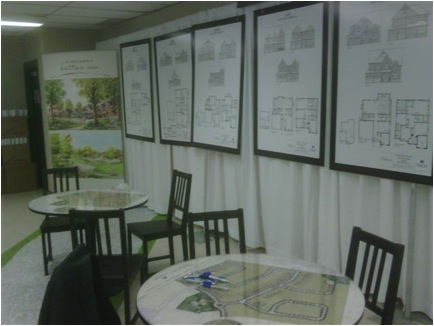
3. We hosted our blueprint preview events in a rented basement in a local community centre. We sold homes off of black-and-white blueprint drawings.

4. We created urgency and excitement by reminding buyers that the sooner they buy, the more money they will save.

5. We also reminded them that buying early lets them choose the best homesites.

The results? We sold 68 homes in 4 days of appointments.

Once the Presentation Centre was finally ready to be opened this May, we had yet another Preview Opening by appointment only. This resulted in another 50 home purchases.

But it all started from black-and-white blueprints displayed in a basement, before the presentation centre had even opened.

Do You Like a Good Deal?

raw coins & leaves... (part 2)

So, do you like a good deal?

If you’re Canadian, you most likely do. At least that’s what a new report says as quoted by the Toronto Star last Tuesday.

This makes sense. Who doesn’t like a good deal? Doubtless people of all nationalities are happy to pay less.

The difference, according to the Toronto Star, is that us Canadians are among the most likely in the world to “buy on a deal.”

In fact, we rank second only to Italians in deal-hunting.

Think about that. Second in the whole world.

What do these stats prove? What do the popularity surges of sites like Groupon and Toronto-based Dealfind prove?

Nothing that we didn’t know before. I’ll grant that. But they do make a stronger case that we must create a sense of urgency in potential homeowners and that we must create the perception of value.

We must give something away—or they will walk away into the arms of the next homebuilder, the one who is offering a deal.

Let’s Not Write Off Texting Yet

Texting on the Float

The Goddess of Texting is alive and well.

Say Gary is a potential homebuyer who’s interested in learning about homes from a specific builder. Rushing to his car after work, Gary drives through heavy traffic to the presentation centre—only to find it’s closed.

Even worse: scowling at the hours sign, Gary learns that the centre opens late and closes early, making it hard for him to get there before or after work.

Gary isn’t pleased. And you know what that means: a displeased potential homebuyer may no longer be a potential homebuyer.

We at BAM are working hard to help our clients solve this problem. As always, we want to do it in an efficient, cost-effective way. So we looked at cheap, ubiquitous technology.

The best option, in our opinion?

Plain old texting.

I’ve already blogged about texting and its relation to advertising campaigns for communities. We like using text messages to communicate with potential homebuyers. Texts are harder to miss than email. They’re also instant, personal, and ever-present. (According to a recent Toronto Star article, Canadians sent 56.4 billion texts in 2010, up 60% from 2009. That’s an average of 154.5 million a day, despite us having more and more digital messaging options.)

In view of such ubiquity, it would be foolish not to tap into the potential of texting.

Back to Gary. Imagine he sees a sign when he gets to the presentation centre. The sign urges him to send a text to a specific number with a keyword attached to it (in this case, that keyword would probably be “Info”). Gary does as asked, and immediately gets a text back that says, “Welcome. My name is Brent. You can reach me at (…) and I’ll answer any questions you have!”

All of a sudden, Gary’s not alone in front of a closed store anymore. He’s a potential homebuyer again, in direct contact with you.

Alternatively, if Gary is circling the presentation centre in his car, he could see a sign saying, “Move-in Special,” with a number to text below that. If Gary were to send a text to it, he’d get a tailored reply.

These messages could contain any type of information. Smartphone users could get a link to a video. Any user could register via a simple text. And if potential homebuyers are lost, they could get directions sent directly to their device. Depending on which sign they see, they’ll text to a different keyword, which will return a different set of directions depending on the location of the sign.

Texting will allow us to engage further with homebuyers, providing better customer service and being there for them even after staff go home.

Previous Older Entries Next Newer Entries